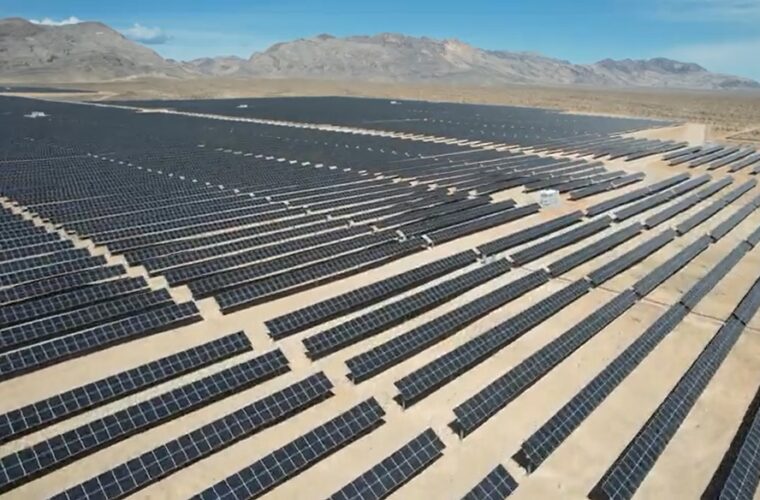
Perched on arid land near the Moapa River Indian Reservation, the Eagle Shadow Mountain Solar Farm is more than a power plant; it is a landmark project signaling Nevada’s pivotal role in the national clean energy transition. As one of the largest solar facilities in the United States upon its completion, it represents a monumental collaboration between private enterprise, utility providers, and tribal neighbors, setting a new benchmark for scale and innovation in the Western solar industry.
Significance & Context
The Eagle Shadow Mountain Solar Farm is a monumental 300-megawatt (AC) facility developed by 8minute Solar Energy on private land within Clark County. Its power is purchased by NV Energy to serve customers across Nevada, directly supporting the state’s policy goals for renewable portfolio standards. The project’s sheer capacity is significant, generating enough electricity to power approximately 90,000 homes. This output displaces a substantial volume of fossil fuel generation, preventing an estimated 600,000 metric tons of carbon dioxide emissions annually—a critical step toward reducing the regional carbon footprint.
Development Timeline
The project’s development journey began with land acquisition and early-stage planning around 2017. A key milestone was reached in 2019 when NV Energy selected the project in its Integrated Resource Plan filing with the Public Utilities Commission of Nevada (PUCN). After securing necessary local permits from Clark County, construction commenced in 2020. Despite global supply chain challenges, the project was built in phases and achieved full commercial operation in 2023.
Technology & Innovation
The Eagle Shadow Mountain facility leverages cutting-edge technology to achieve its massive scale and efficiency. It utilizes bifacial solar panels mounted on single-axis trackers. This combination allows the modules to capture direct sunlight on the front and reflected light on the rear, while the tracking system follows the sun’s path. According to technical analyses from the National Renewable Energy Laboratory (NREL), this configuration can boost energy production by over 30% compared to fixed-tilt systems. The project also features a sophisticated electrical system to efficiently feed power into the grid.
Challenges & Controversies
A significant challenge for the project involved navigating its scale and proximity to the Moapa Band of Paiute Indians. Early concerns were raised regarding visual impact, water usage for construction dust control, and potential effects on cultural resources. To resolve these, the developer, 8minute Solar Energy, engaged in extensive government-to-government consultation with the Tribe. This led to the creation of a Community Benefits Agreement, which included measures to minimize environmental impact, provide job opportunities, and deliver direct economic benefits to the Moapa community, turning potential opposition into a partnership.
Community & Economic Impact
The Eagle Shadow Mountain Solar Farm has delivered substantial economic benefits to Clark County and its tribal neighbors. During its multi-year construction phase, the project typically employed over 500 workers at peak, providing a major boost to the local labor market. For long-term operations, it maintains a team of permanent technicians. The project provides a steady stream of land lease payments to private landowners. Based on Nevada’s tax abatement programs for renewables and local assessment models, the project likely contributes millions of dollars in tax revenue over its lifetime to Clark County, funding essential public services. The Community Benefits Agreement with the Moapa Band also ensures direct, ongoing economic support.
Future Outlook
The Eagle Shadow Mountain Solar Farm is a long-term asset for Nevada’s energy grid, with an operational lifespan exceeding 30 years. Its success demonstrates the viability of ultra-large-scale solar development in the state and paves the way for future projects. The site’s infrastructure is designed to potentially accommodate future battery energy storage systems (BESS), which would allow solar energy generated during the day to be dispatched during peak evening hours, further enhancing grid reliability. The project’s collaborative model with tribal nations sets a precedent for responsible development that other large-scale renewable projects in the West are likely to follow.
See also at Clark: Arrow Canyon Solar Hybrid