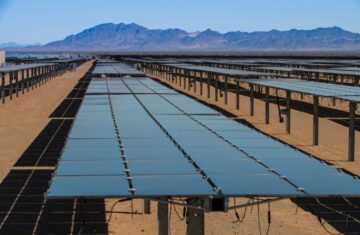
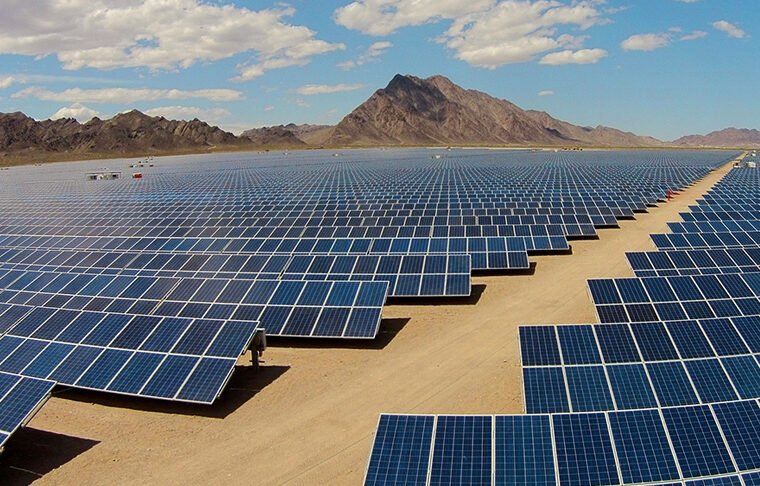
Just outside Boulder City, Nevada, the Copper Mountain Solar 3 facility represents a significant milestone in the evolution of utility-scale solar technology, demonstrating how continuous innovation drives down costs while increasing efficiency in renewable energy generation. This project completed the largest solar complex in the United States when it came online, showcasing Nevada’s rapid transformation into a national leader in utility-scale solar development.
Significance & Context
Developed by Sempra Renewables, the 250-megawatt (MW) Copper Mountain Solar 3 expansion brought the total complex capacity to 802 MW, making it the largest solar power facility in the country upon completion. According to generation data from the U.S. Energy Information Administration (EIA), the entire complex produces enough electricity to power approximately 260,000 homes, significantly contributing to Nevada’s renewable portfolio standard and supplying power to NV Energy‘s grid. Its location in Clark County, strategically situated near the Hoover Dam’s transmission infrastructure, positions it to efficiently deliver renewable energy to major Southwest population centers.
Development Timeline
The project’s development built upon the success of previous phases to accelerate deployment. Development activities began in 2014, with construction commencing in 2015 following power purchase agreements with Pacific Gas & Electric. The project achieved commercial operation in 2016, as documented in Federal Energy Regulatory Commission (FERC) filings, representing an accelerated timeline that leveraged existing site knowledge and infrastructure from Copper Mountain Solar 1 and 2. This phased approach demonstrated how sequential development can optimize costs and reduce implementation timelines for large-scale solar complexes.
Technology & Innovation
Copper Mountain Solar 3 utilized advanced single-axis tracking systems with crystalline silicon photovoltaic modules, featuring improved efficiency and durability over previous generations. According to technical reports from the National Renewable Energy Laboratory (NREL), the project incorporated next-generation inverters with advanced grid-support functions that provided voltage regulation and frequency response capabilities. The facility also implemented a sophisticated water management system that reduced water usage for panel cleaning by 75% compared to conventional methods, employing automated, water-efficient robotic cleaners and air-blowing systems adapted for desert conditions.
Challenges & Controversies
The expansion faced challenges related to scale and grid integration. The project’s size raised concerns about voltage stability and potential grid congestion in the region. These technical challenges were resolved through close coordination with NV Energy and the Southwest Transmission Group, implementing advanced inverter settings and grid management protocols that established new technical standards for large-scale solar integration. Environmental concerns regarding desert habitat were addressed through an enhanced mitigation plan developed with the U.S. Bureau of Land Management, including additional habitat conservation measures and funding for desert tortoise protection programs.
Community & Economic Impact
For Clark County and Boulder City, the project delivered substantial economic benefits during both construction and operation. During its construction phase, the project typically employed 400-500 workers, with significant local hiring from the Las Vegas metropolitan area. For ongoing operations, the entire complex maintains 25-30 permanent positions. Based on Clark County’s tax assessment models for utility-scale solar, the expansion likely contributes approximately $1.5-2 million annually in additional property tax revenue to local governments. The project also provides lease payments to the city of Boulder City, supporting municipal services and helping to maintain the community’s status as debt-free.
Future Outlook
With an expected operational lifespan of 30+ years, the Copper Mountain Solar 3 expansion solidifies Nevada’s position as a solar energy leader. The project’s success has inspired additional renewable development in the region, contributing to Boulder City’s transformation into a renewable energy hub. As technology advances, the complex is well-positioned for potential repowering with more efficient panels or integration with energy storage systems. The project’s technical innovations in grid integration continue to inform industry standards, while its approach to sequential development provides a model for optimizing large-scale renewable energy complexes. As Nevada continues toward its goal of 50% renewable energy by 2030, the Copper Mountain complex remains a cornerstone of the state’s clean energy transition.