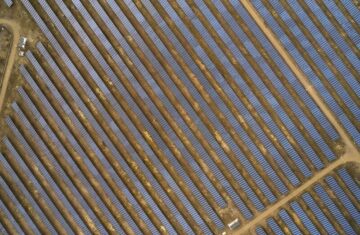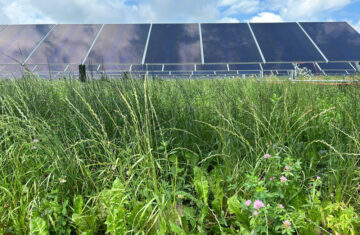
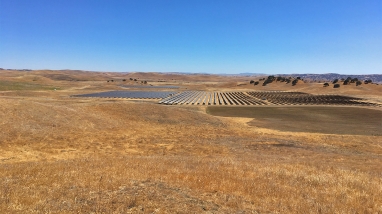
CA Flats Solar 130 project represents a strategic refinement of agrivoltaic development, building upon earlier successes to optimize the integration of solar energy production with active farming operations. This project demonstrates how iterative improvements in dual-use solar technology can enhance both energy output and agricultural productivity while addressing community concerns about land use conversion.
Significance & Context
Developed by Recurrent Energy, the 130-megawatt (MW) CA Flats Solar 130 facility expands upon the proven agrivoltaic model established by its predecessor, further advancing the compatibility of large-scale solar development with agricultural preservation. According to generation data from the California Energy Commission, the facility produces enough electricity to power approximately 47,000 homes while maintaining agricultural operations across portions of the site. Its location in San Luis Obispo County positions it within a region increasingly focused on sustainable land use practices that balance renewable energy goals with the preservation of California’s agricultural heritage.
Development Timeline
The project’s development benefited from lessons learned during earlier agrivoltaic implementations. Development activities began in 2018, with the project receiving approval from the San Luis Obispo County Planning Commission in 2020. Construction commenced in 2021, achieving commercial operation in 2023, as documented in Pacific Gas & Electric interconnection records. This streamlined timeline reflected the county’s growing experience with agrivoltaic projects and the developer’s refined approach to dual-use design, though it still required comprehensive environmental review and community engagement processes.
Technology & Innovation
CA Flats Solar 130 utilizes elevated single-axis tracking systems with advanced bifacial photovoltaic modules, featuring improved clearance and spacing based on operational data from earlier projects. According to research from the National Renewable Energy Laboratory (NREL), this optimized design increases both energy yield and agricultural compatibility compared to previous configurations. The project incorporates smart irrigation technology that adjusts water delivery based on microclimate conditions under the solar arrays, reducing water usage by approximately 25% compared to conventional farming methods. Enhanced monitoring systems track both energy production and crop performance in real time, providing valuable data for future agrivoltaic optimization.
Challenges & Controversies
The project faced ongoing challenges related to scaling agrivoltaic systems and addressing concerns about economic viability for certain crop types. Some local farmers remained skeptical about the practicality of commercial-scale farming beneath solar arrays. The resolution involved implementing a Phased Agricultural Implementation Plan that allowed for different farming approaches across the site, including areas dedicated to research and demonstration plots managed by California Polytechnic State University. This approach provided flexibility to adapt methods based on actual performance data and addressed concerns by maintaining significant portions of the site for conventional agriculture while gradually expanding dual-use areas as techniques proved successful.
Community & Economic Impact
For San Luis Obispo County, the project has delivered enhanced economic benefits through refined dual-use approaches. During construction, the project typically employed 180-220 workers, with continued emphasis on local hiring. For ongoing operations, it maintains 7-10 permanent positions while supporting 15-20 agricultural jobs. Based on San Luis Obispo County’s tax assessment models, the project likely contributes approximately $600,000-$800,000 annually in property tax revenue to local governments. The innovative lease structure provides farmers with both base rental income and revenue sharing from energy production, creating a more resilient economic model that benefits both landowners and the agricultural community.
Future Outlook
With an expected operational lifespan of 30+ years, the CA Flats Solar 130 project serves as an advanced testing ground for next-generation agrivoltaic systems. The project’s comprehensive data collection on microclimate effects, crop yields, and energy production continues to inform agricultural and energy policy at state and national levels. As technology advances, the site may incorporate additional innovations such as specialized light-spectrum optimizing panels or automated farming equipment designed for dual-use environments. The project’s success in balancing scale with agricultural preservation provides a replicable model for other regions seeking to meet renewable energy targets while maintaining working landscapes, demonstrating that careful planning and continuous improvement can create sustainable solutions for both energy and food production.
See also: CA Flats Solar 150