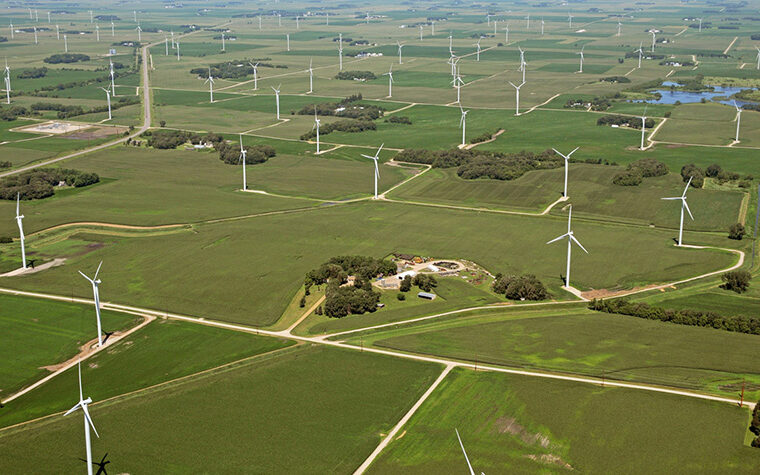
Rising from the agricultural fields of Freeborn County, Minnesota, the Bent Tree Wind Farm represents a significant and strategic investment in the state’s renewable energy leadership. As one of the largest wind projects in Minnesota at the time of its construction, it underscored the economic and technical viability of harnessing the Midwest’s wind resources at a massive scale, delivering clean power to the grid while establishing a deep and lasting partnership with its host community.
Significance & Context
The Bent Tree Wind Farm, developed by Alliant Energy, is a major pillar in Minnesota’s energy portfolio. With a substantial installed capacity of 201 megawatts (MW), the facility generates enough electricity to power approximately 60,000 Minnesota homes annually, based on calculations from the U.S. Energy Information Administration (EIA). Its output is integrated into the Midcontinent Independent System Operator (MISO) grid, a contribution tracked by the Minnesota Department of Commerce, Division of Energy Resources. The project was a critical component of Alliant Energy’s strategy to expand its renewable generation.
Development Timeline
The project’s development followed a comprehensive utility-led process. Initial site prospecting began in the late 2000s. After navigating permitting and receiving a Certificate of Need from the Minnesota Public Utilities Commission (PUC), construction commenced in 2009. The Bent Tree Wind Farm reached commercial operation in 2011, a date confirmed by its listing in the U.S. Wind Turbine Database and utility press releases.
Technology & Innovation
The project employed a large fleet of turbines, featuring 122 Siemens (now Siemens Gamesa) 2.3 MW and 1.65 MW turbines. A key focus was optimizing the layout across a large area, a practice informed by wind resource assessment tools and research from the National Renewable Energy Laboratory (NREL). The project incorporated a sophisticated Supervisory Control and Data Acquisition (SCADA) system for remote monitoring.
Challenges & Controversies
A central challenge was addressing concerns from some county residents regarding the project’s sheer scale and its visual impact. This hurdle was resolved through a prolonged county review process. Alliant Energy conducted public meetings and agreed to operational mitigations within the county’s conditional use permit. The Freeborn County Board of Commissioners ultimately approved the project, swayed by the long-term economic benefits. The permit and related decisions are accessible through county records.
Community & Economic Impact
For Freeborn County, the wind farm has been an economic cornerstone. During peak construction, the project typically employed over 300 workers, according to industry models from the American Clean Power Association. Its lasting legacy is tens of millions in property tax revenue, providing transformative funding for county services and schools, as detailed in Freeborn County financial reports. Furthermore, it provides guaranteed annual lease payments to participating farmers, a benefit for the agricultural economy supported by the University of Minnesota Extension.
Future Outlook
As a mature and utility-owned asset, the Bent Tree Wind Farm is a reliable, long-term generator. Given its age, the project will eventually enter the planning phase for repowering, a strategy analyzed in NREL reports on wind plant modernization. This could potentially double the site’s output, triggering a new cycle of local investment and refreshed revenue, aligning with Minnesota’s clean energy goals under the Minnesota Climate Action Framework and MISO’s long-term planning, accessible through MISO’s MTEP.
At Garfield County you can find also: Lower Snake River Wind Energy Project