
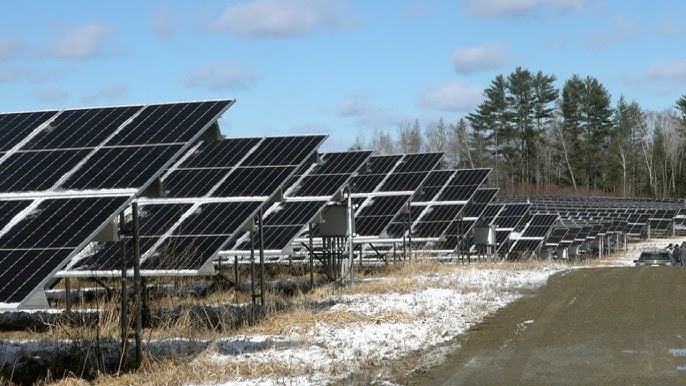
Tucked into the rolling landscape of western Massachusetts, the Stony Brook Solar Farm represents how small but deliberate steps can have an outsized impact on a region’s clean energy ambitions. With a modest capacity of 6.9 megawatts (MW AC), the project may not rival the sweeping deserts of the Southwest or the sprawling solar fields of Texas, but in the context of New England’s evolving grid, it has become a cornerstone of localized resilience and sustainability.
The farm sits in an area historically shaped by agriculture and light manufacturing, industries that once defined the tax base but have gradually declined over decades. By repurposing underutilized land for energy generation, Stony Brook Solar diversifies income streams for landowners while boosting the municipal budget. Projects of this scale typically inject $10–15 million in capital investment, with ripple effects that include construction contracts for local firms, lease payments to rural landowners, and a long-term contribution to the property tax base. In a small community, even a few hundred thousand dollars in annual tax revenue can make the difference between maintaining a school program or cutting it.
Technically, the farm relies on monocrystalline photovoltaic panels mounted on single-axis trackers, a proven choice for Massachusetts’ latitude where maximizing sunlight capture is critical. This configuration allows the panels to follow the sun’s path throughout the day, improving generation efficiency by up to 25% compared with fixed-tilt arrays. The output—enough to power approximately 1,200 average New England homes each year—displaces fossil-fuel generation that would otherwise release more than 5,000 metric tons of CO₂ annually. That figure is equivalent to taking over 1,000 cars off the road, a meaningful local contribution to Massachusetts’ legally binding target of net-zero greenhouse gas emissions by 2050 (Mass.gov).
The development of Stony Brook Solar was not without challenges. Like many renewable projects in the Northeast, it required navigating a complex permitting process that balanced environmental reviews, interconnection studies with ISO New England, and concerns from neighbors about land use and visual impact. Ultimately, transparent engagement and a commitment to wildlife buffers and stormwater management allowed the project to move forward with broad community support.
Beyond the immediate output, the project carries long-term strategic importance. Distributed solar farms like Stony Brook reduce reliance on distant power plants, lowering transmission congestion and strengthening grid reliability in regions vulnerable to winter storms and price volatility. Moreover, as Massachusetts utilities continue to expand programs for solar-plus-storage, Stony Brook is positioned as a strong candidate for future battery integration. Such an upgrade would not only extend its impact into evening peak hours but also fortify local resilience against outages.
In the broader story of Massachusetts’ energy transition, Stony Brook Solar Farm may be modest in size, but it reflects the philosophy that the clean energy transition is built one community at a time. For local residents, it is more than a cluster of panels; it is a signal that their town is part of the state’s clean energy roadmap, delivering both climate action and economic stability.
The key specifications for the Stony Brook Solar Farm are detailed in the table below.