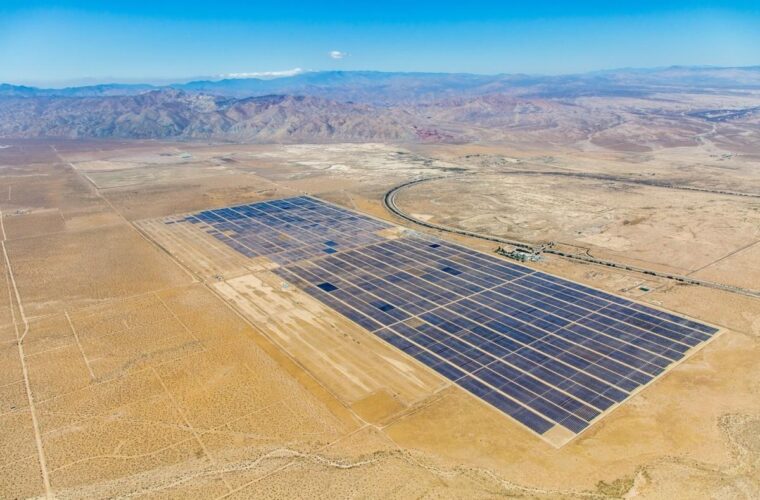
Rising from the sun-drenched landscape of California’s Central Valley, the Springbok Solar Farm 1 represents a pivotal development in the state’s strategic shift toward utility-scale renewable energy, demonstrating how solar projects can be rapidly deployed to meet ambitious climate goals while creating economic opportunities in agricultural regions. This project exemplifies the new generation of solar development that balances clean energy production with responsible land use practices in one of California’s most productive agricultural counties.
Significance & Context
Developed by EDF Renewables, the 137-megawatt (MW) Springbok Solar Farm 1 forms part of a larger solar complex that has become a significant contributor to Southern California’s renewable energy portfolio. According to generation data from the California Energy Commission, the facility produces enough electricity to power approximately 52,000 homes while offsetting nearly 110,000 tons of carbon dioxide emissions annually. Its location in Kern County, which has emerged as a renewable energy hub, positions it strategically to serve the Los Angeles Basin while leveraging the region’s exceptional solar resources and established energy infrastructure.
Development Timeline
The project’s development progressed rapidly during California’s accelerated renewable energy expansion. Development activities began in 2012, with construction commencing in 2014 following power purchase agreements with Southern California Edison. The project achieved commercial operation in 2015, as documented in California Public Utilities Commission filings, demonstrating the efficiency of Kern County’s established permitting processes for utility-scale solar projects. This relatively swift timeline from conception to operation highlighted the growing maturity of the solar industry and California’s commitment to rapid renewable deployment.
Technology & Innovation
Springbok Solar Farm 1 utilizes single-axis tracking systems with crystalline silicon photovoltaic modules, optimized for the Central Valley’s solar conditions. According to performance data from the National Renewable Energy Laboratory (NREL), the tracking technology increases energy production by approximately 20-25% compared to fixed-tilt systems. The project incorporated advanced inverters and grid management systems that provided valuable voltage support and frequency regulation services to the local grid, enhancing overall system reliability and demonstrating how solar facilities can provide ancillary services beyond simple energy generation.
Challenges & Controversies
The project faced significant challenges related to land use competition in California’s agriculturally vital Central Valley. Local farming advocates and some residents expressed concerns about the conversion of agricultural land to industrial solar use. The resolution involved implementing a comprehensive Agricultural Protection Plan developed in coordination with the Kern County Planning and Natural Resources Department, which included maintaining agricultural operations on portions of the site and implementing sheep grazing for vegetation management. The project also addressed water management concerns by using water-efficient robotic cleaning systems and implementing stormwater management practices that protected local watersheds.
Community & Economic Impact
For Kern County, the project has delivered substantial economic benefits while navigating agricultural land use considerations. During construction, the project typically employed 250-300 workers, with targeted local hiring programs. For ongoing operations, it maintains 8-12 permanent positions. Based on Kern County’s tax assessment models for utility-scale solar, the project likely contributes approximately $600,000-$800,000 annually in property tax revenue to local governments and school districts. Additionally, it provides stable lease payments to local landowners, creating a drought-resistant income source that complements agricultural revenues and provides financial stability for farming operations.
Future Outlook
With an expected operational lifespan of 30+ years, the Springbok Solar Farm 1 represents a long-term energy asset for California’s grid. The project’s success has contributed to Kern County’s emergence as a renewable energy leader, with the area now hosting multiple utility-scale solar facilities. As technology advances, the site may eventually be repowered with more efficient panels, potentially increasing output without expanding its footprint. The project’s approach to balancing solar development with agricultural preservation continues to inform policy discussions about sustainable land use in California’s productive agricultural regions, demonstrating that renewable energy and agriculture can coexist through thoughtful planning and innovative approaches.