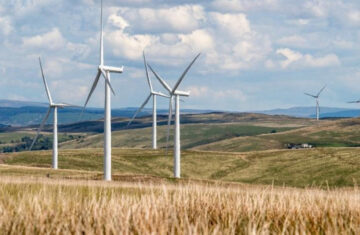
In the windswept hills of southeastern Washington, the Hopkins Ridge Wind Farm stands as a pioneering development in the Pacific Northwest’s renewable energy landscape. As one of the first utility-scale wind projects in the region, it demonstrated the viability of harnessing the Columbia River Plateau’s robust wind resources for commercial power generation. This landmark project helped establish the technical and economic framework for subsequent wind developments across Washington and Oregon, proving that wind energy could be a significant contributor to the region’s diverse energy portfolio.
Significance & Context
The Hopkins Ridge Wind Farm was a strategically important addition to the Bonneville Power Administration (BPA) grid, which serves the Pacific Northwest. Its development marked a significant expansion of renewable energy in a region historically dominated by hydroelectric power. The project helped validate Washington’s wind resources at a commercial scale and contributed to the state’s early renewable energy goals, providing valuable operational data that informed subsequent wind developments throughout the region—a trend later tracked by the Washington State Department of Commerce.
Development Timeline
Development for Hopkins Ridge began in the early 2000s, during a period of growing interest in wind power as a viable complement to the region’s hydroelectric system. Key milestones included securing land leases from local ranchers, conducting extensive wind resource assessment, and navigating the permitting process for one of the region’s first major wind facilities. Construction was completed in 2005, with the project achieving commercial operation in 2006 after a comprehensive development and testing phase.
Technology & Innovation
For its time, Hopkins Ridge utilized state-of-the-art wind turbine technology, featuring turbines that were considered large and efficient at the time of installation. The project demonstrated the feasibility of integrating wind power into a hydroelectric-dominated grid, providing valuable insights into managing the variability of wind generation. Its successful operation helped prove the reliability of wind technology in the specific climatic conditions of the Columbia Plateau, including its ability to withstand seasonal temperature extremes.
Challenges & Controversies
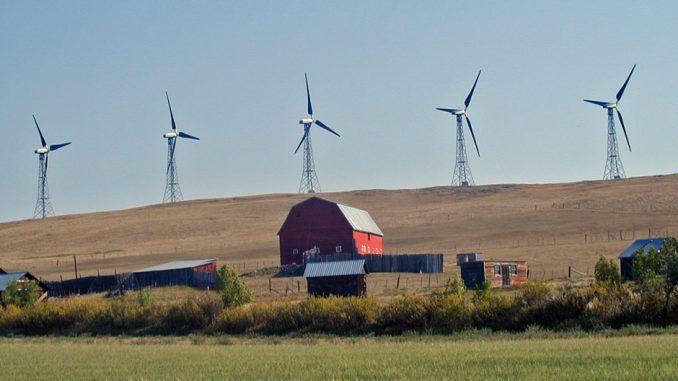
A significant challenge for the Hopkins Ridge project was addressing the novelty of utility-scale wind power in a region with limited prior exposure to the technology. Some local residents expressed concerns about visual impacts, noise, and the overall concept of large-scale wind development. This challenge was resolved through extensive public education efforts, open houses, and site visits that demonstrated how wind generation could coexist with traditional agricultural uses, as farming and grazing continued undisturbed beneath the turbines.
Community & Economic Impact
For Columbia County, the Hopkins Ridge Wind Farm introduced a new model for economic development. During construction, the project typically employed approximately 150 workers, providing a significant boost to the local economy. The permanent operations team created 15-20 long-term technical positions. The project likely contributed a substantial stream of property tax revenue, supporting local public services—a benefit documented by the Washington Department of Revenue. Landowners received a new source of lease income that complemented their agricultural operations.
Future Outlook
As one of the Pacific Northwest’s pioneering wind projects, the Hopkins Ridge Wind Farm has provided nearly two decades of clean energy and continues to be a valuable asset in the region’s power supply. The site’s proven wind resource and established grid connection make it a potential candidate for future repowering with contemporary turbine technology, which could significantly increase its energy output. The project’s enduring legacy is its role in demonstrating the technical and economic feasibility of wind energy in the region, paving the way for the significant wind capacity that now contributes to Washington’s clean energy goals.
Find also at Washington: Wild Horse wind farm