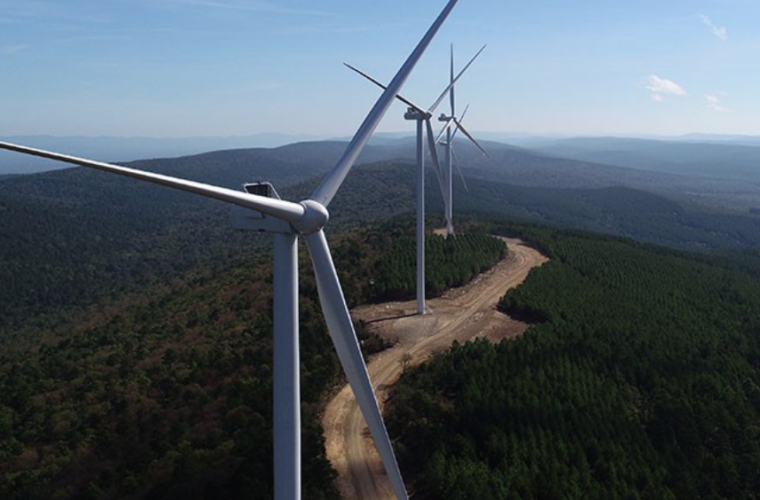
Nestled in the forested ridges of Greenbrier County, West Virginia, the Beech Ridge Energy project represents a pioneering venture into wind power for the Mountain State. As one of West Virginia’s first utility-scale wind farms, it navigated a complex landscape of challenging terrain, environmental scrutiny, and regulatory novelty to establish a foothold for renewable energy in a region historically defined by coal, setting a precedent for the technical and political feasibility of wind in Appalachia.
Significance & Context
The Beech Ridge Energy wind farm, developed by Beech Ridge Energy LLC (a subsidiary of Invenergy), is a landmark project in West Virginia’s energy portfolio. With a total installed capacity of 100.5 megawatts (MW), the facility generates enough electricity to power approximately 30,000 West Virginia homes annually, based on calculations from the U.S. Energy Information Administration (EIA). Its output is delivered into the PJM Interconnection grid, a contribution tracked by the West Virginia Department of Economic Development – Energy Office. Its development was significant for proving that large-scale wind projects could be engineered in the state’s mountainous topography.
Development Timeline
The project’s development was protracted, reflecting its status as a pathfinder. Initial planning began in the early 2000s. The project faced significant legal challenges, including a lawsuit that reached the U.S. Court of Appeals for the Fourth Circuit. After years of litigation and rigorous permitting, construction finally commenced in the late 2000s. The Beech Ridge Energy project achieved commercial operation in 2010, a date confirmed by its listing in the U.S. Wind Turbine Database.
Technology & Innovation
The project’s primary innovation was its adaptation of wind turbine technology to a heavily forested, mountainous environment. Building the wind farm required constructing over 23 miles of access roads and clearing limited ridgetop areas for 67 GE Wind Energy 1.5 MW turbines. The civil engineering challenges were substantial, involving techniques later documented in contexts like those studied by the National Renewable Energy Laboratory (NREL) on forestry and wind.
Challenges & Controversies
The most significant challenge was a high-profile legal battle over compliance with the Endangered Species Act, specifically regarding the potential impact on the federally listed Indiana bat. This hurdle was resolved through a landmark 2011 settlement agreement and a subsequent Habitat Conservation Plan (HCP). Invenergy agreed to extensive mitigation measures, including permanent land conservation and operational curtailments. The legally binding agreement, approved by the U.S. Fish and Wildlife Service (USFWS), set a national precedent. Key court documents are accessible via Public Access to Court Electronic Records (PACER).
Community & Economic Impact
For Greenbrier County, the wind farm introduced a new source of long-term revenue. During its construction, the project typically employed 200-300 workers, according to industry models from the American Clean Power Association. Operationally, it generates a steady stream of property tax revenue, contributing to local government and school funding, as detailed in Greenbrier County financial records. Additionally, it provides annual lease payments to participating landowners, offering timberland owners a new income stream, a dynamic supported by the West Virginia University Extension Service.
Future Outlook
As a mature asset, Beech Ridge Energy continues to operate under the constraints of its Habitat Conservation Plan. Its legacy is complex, serving as both a proof-of-concept and a case study in environmental conflict. Given its specific operating restrictions and site challenges, a future repowering effort seems unlikely. The project’s long-term future is tied to its HCP, and it remains a singular example in West Virginia’s energy dialogue, within the framework of PJM’s regional planning accessible through PJM’s Grid Planning reports.
At Bureau County you can find also: Big Sky Wind