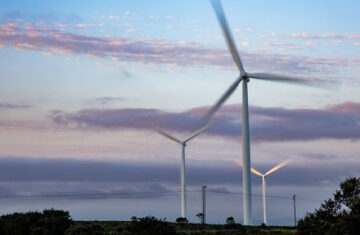
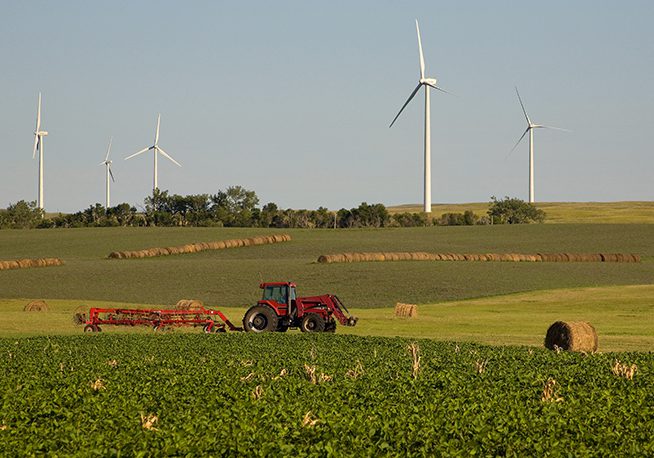
Tatanka Wind Power project represents a unique bi-state collaboration that harnesses the exceptional wind resources of the Northern Plains. This facility demonstrates how cross-jurisdictional renewable energy projects can deliver economic benefits to multiple communities while contributing significant clean power to the regional grid.
Significance & Context
The Tatanka Wind Power project is a 180-megawatt (MW) facility located in Dickey County, North Dakota, and McPherson County, South Dakota. Developed by Acciona Energy, the project was one of the first major wind installations in this border region. Its electrical output is sold to Basin Electric Power Cooperative, providing clean energy to the generation and transmission cooperative’s member systems across the upper Midwest. The facility powers approximately 60,000 homes and represents a capital investment of nearly $300 million.
Development Timeline
Development for Tatanka Wind Power began in the mid-2000s, with construction commencing in 2007. The project required careful coordination between regulatory authorities in both states, particularly regarding interconnection with the Midcontinent Independent System Operator (MISO) grid. Despite the complexity of permitting across two jurisdictions, the project achieved commercial operation in 2008, establishing an important precedent for future cross-border renewable development in the region.
Technology & Innovation
The wind farm utilizes 61 Acciona Windpower 3.0-MW turbines, which were among the larger models available at the time of installation. A key innovation was the project’s dual-state infrastructure design, which required careful engineering to manage electrical collection across state lines while meeting the regulatory requirements of both North Dakota and South Dakota. This established a template for subsequent wind developments along state borders in the MISO territory.
Challenges & Controversies
A significant challenge was navigating the different regulatory frameworks and community expectations in two states with distinct permitting processes and tax structures. The developer addressed this by maintaining transparent communication with county officials in both Dickey and McPherson Counties, harmonizing community benefit agreements, and ensuring consistent environmental monitoring across the project footprint. This collaborative approach helped build trust and secure necessary approvals from both jurisdictions.
Community & Economic Impact
The project delivers economic benefits to both Dickey County, ND and McPherson County, SD. During construction, Tatanka Wind Power typically employed over 200 workers, with hiring from both states. The project continues to support operations and maintenance positions drawn from the local area. Over its operational life, the project likely contributes millions of dollars in property tax revenue to both counties, supporting essential services in these rural areas. Participating landowners in both states receive stable lease payments that complement agricultural income.
Future Outlook
Now well into its operational life, Tatanka Wind Power continues to be a reliable contributor to the region’s energy supply. As one of the earlier projects in the area, it represents a potential candidate for future repowering efforts. As analyzed by the National Renewable Energy Laboratory (NREL), modernizing the facility with newer turbine technology could significantly increase its output. The project’s success in navigating dual-state development has provided a valuable blueprint for subsequent renewable energy projects in the border region between North and South Dakota.
At Klickitat County you can find also: Goodnoe Hills wind farm