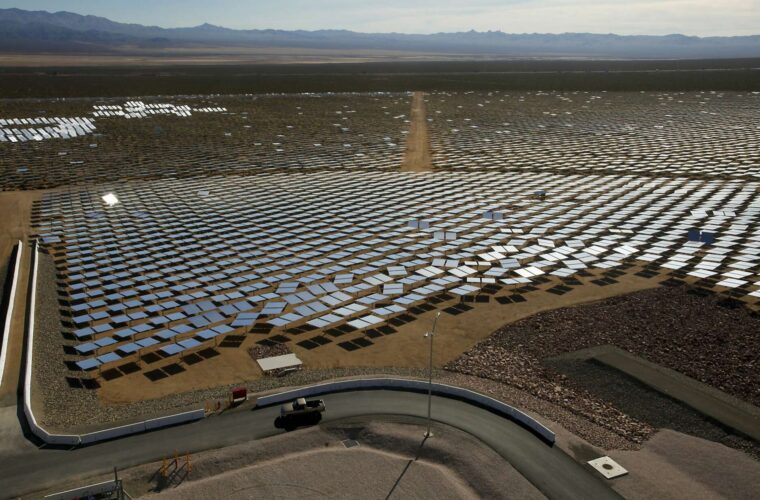
Situated in the sun-drenched expanse of California’s high desert, the Mojave Solar Project in San Bernardino County stands as a major contributor to the state’s renewable energy portfolio. This large-scale concentrated solar thermal power (CSP) facility exemplifies a strategic shift toward utility-grade clean energy generation, designed to provide reliable power while supporting the state’s ambitious climate goals. Its development, supported by significant federal financing, underscores the critical role of innovative solar technology in achieving a decarbonized grid.
Significance & Context
The Mojave Solar Project is a key asset in meeting California’s mandate to derive 60% of its electricity from renewable sources by 2030, as established by Senate Bill 100. Developed by Abengoa Solar, the 280-megawatt (MW) facility utilizes parabolic trough technology to generate enough electricity to power approximately 88,000 households, according to capacity and generation data from the California Energy Commission. By offsetting over 430,000 tons of carbon dioxide emissions annually, the project plays a substantial role in reducing the state’s reliance on natural gas.
Development Timeline
The project’s development began in 2007, with a critical milestone reached upon signing a power purchase agreement with Pacific Gas and Electric (PG&E). Construction commenced in 2011, leveraging a $1.2 billion loan guarantee from the U.S. Department of Energy to mitigate financial risk. As documented in SEC filings and press releases from Abengoa, the facility achieved commercial operation in December 2014 after overcoming regulatory and logistical hurdles.
Technology & Innovation
The Mojave Solar Project employs parabolic trough technology, using 900,000 mirrors to concentrate sunlight onto receiver tubes containing a heat transfer fluid. This fluid generates steam to drive turbines. A key innovation, detailed in technical reports by the National Renewable Energy Laboratory (NREL), is its thermal energy storage system. This system uses molten salt to store heat, allowing the plant to generate electricity for several hours after sunset, providing crucial grid stability.
Challenges & Controversies
The project faced significant environmental challenges. Conservation groups raised concerns about impacts on local wildlife, particularly the desert tortoise. To resolve this, the developers implemented a comprehensive Desert Tortoise Translocation Program, in coordination with the California Department of Fish and Wildlife, relocating specimens to protected habitats. Additionally, the use of groundwater sparked concerns. The project addressed this by employing air-cooled condensers, a technology noted in the project’s Environmental Impact Report, reducing water consumption by over 90% compared to wet-cooled systems.
Community & Economic Impact
The Mojave Solar Project has delivered meaningful economic benefits to San Bernardino County. During construction, it typically employed over 830 workers, as reported in economic impact studies commissioned by the county. For ongoing operations, it maintains a team of approximately 50 full-time staff. The project likely contributes substantial property tax revenue to the county, supporting public services. Additionally, it provides lease payments to landowners, offering a stable income source.
Future Outlook
With an expected operational lifespan of 30 years, the Mojave Solar Project is a long-term asset. As the state’s grid evolves, the project’s thermal storage capability positions it well to complement intermittent renewables. Its performance is continuously monitored by entities like the U.S. Energy Information Administration (EIA). Its success demonstrates the viability of CSP technology and serves as a reference for future projects aiming to balance scale, reliability, and environmental stewardship.