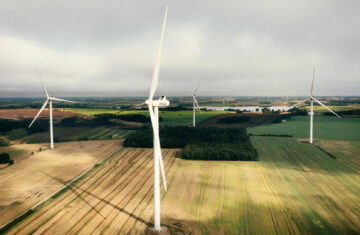
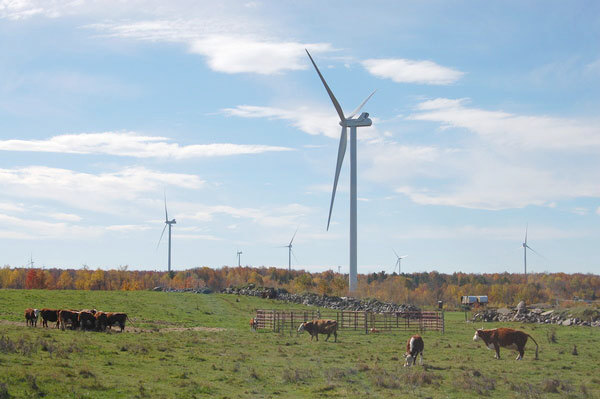
Dominating the landscape near the Canadian border in upstate New York, the Marble River Wind Farm stands as a titan of renewable energy in the Empire State. As one of the state’s largest wind facilities, developed by Iberdrola Renewables, it exemplifies New York’s aggressive push to decarbonize its grid, transforming the winds of the North Country into a massive source of homegrown, carbon-free electricity.
Significance & Context
The Marble River Wind Farm is a flagship project in New York’s renewable energy landscape. With a total capacity of 321 megawatts (MW), the wind farm generates enough electricity to power approximately 125,000 average New York homes annually, a calculation based on data from the U.S. Energy Information Administration (EIA). This colossal output is a critical component in achieving the ambitious mandates of New York’s Climate Leadership and Community Protection Act (CLCPA), as tracked by the New York State Energy Research and Development Authority (NYSERDA). The project’s power feeds into the state grid managed by the New York Independent System Operator (NYISO), contributing to regional energy security.
Development Timeline
The development of this major infrastructure was a substantial undertaking. Initial site work in the towns of Clinton and Ellenburg began in the mid-2000s. The project navigated a complex permitting process, including the state’s Article 10 review (now 94-c), overseen by the New York State Board on Electric Generation Siting and the Environment. Major construction commenced in 2008, with the multi-phase project reaching full commercial operation by 2012, a timeline documented in the U.S. Wind Turbine Database.
Technology & Innovation
For its time, the project represented a significant scale-up in wind technology. It utilizes a fleet of General Electric (GE) and Siemens wind turbines, primarily in the 1.5 to 2.5 MW class. The design had to account for the region’s heavy snowfall and winter conditions, incorporating cold-climate operational packages informed by research from the National Renewable Energy Laboratory (NREL). Its extensive electrical infrastructure was engineered to reliably deliver its substantial output to the grid.
Challenges & Controversies
A primary challenge was navigating the significant scale of local opposition and the rigorous state siting process. Concerns focused on visual impact, property values, and environmental effects. Iberdrola addressed these through an extensive public involvement program and by revising layouts to mitigate concerns, a process detailed in the project’s publicly available Application for a Certificate of Environmental Compatibility and Public Need. The project’s ultimate approval demonstrated the balance between statewide energy policy and local interests.
Community & Economic Impact
For Clinton County and the host towns, the wind farm is a major economic engine. During its multi-year construction, a project of this scale typically employed 300-500 workers at peak, as modeled in reports from the American Clean Power Association. In perpetuity, it generates millions of dollars in annual tax revenue and Payments-In-Lieu-of-Taxes (PILOT) for local governments and schools, with figures reported in Clinton County budget documents. Additionally, it provides long-term land-lease payments to participating landowners, a significant income source for the agricultural community, as analyzed by organizations like Farmers’ Legal Action Group (FLAG).
Future Outlook
As a foundational asset, the Marble River Wind Farm is expected to operate for decades. Its long-term performance is crucial for New York’s renewable goals. The site is a prime future candidate for repowering—replacing older turbines with newer models—to boost output and extend its life, a strategy supported by NYSERDA’s repowering guidelines and directly aligned with the state’s long-term decarbonization targets under the CLCPA.
At Tazewell County you can find also: Rail Splitter Wind Farm