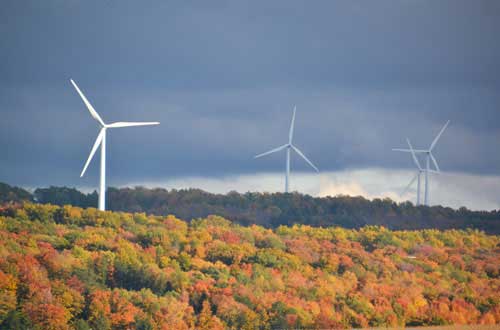
High Sheldon Wind Farm represents a significant evolution in the scale and community-focused design of wind energy in the Northeast. By prioritizing local financial participation and environmental stewardship, this project has become a model for how large-scale renewables can be developed in a way that seeks to maximize long-term benefits for the host community while contributing to statewide clean energy mandates.
Significance & Context
The High Sheldon Wind Farm, developed by Invenergy, is a major contributor to New York’s renewable energy goals under the Climate Leadership and Community Protection Act (CLCPA), detailed by the New York State Energy Research and Development Authority (NYSERDA). With a total installed capacity of 126 megawatts (MW), the facility generates enough electricity to power approximately 40,000 New York homes annually, based on calculations from the U.S. Energy Information Administration (EIA). Its output feeds directly into the New York Independent System Operator (NYISO) grid, a critical part of the state’s energy transition.
Development Timeline
The project’s development emphasized thorough community engagement. Initial site assessment in the Towns of Sheldon and Strykersville began in the mid-2010s. After navigating the state-level Article 10 permitting process, construction commenced in the late 2010s. The High Sheldon Wind Farm achieved commercial operation in 2020, a date confirmed by its listing in the U.S. Wind Turbine Database and noted in NYSERDA’s project tracking.
Technology & Innovation
The project utilizes modern, efficient wind turbines, featuring 47 Vestas V136-3.45 MW turbines. Beyond technology, a key innovation was the establishment of a Host Community Benefit Fund and a structure for local investment. This model for distributing economic benefits is analyzed in reports by the Pace Energy and Climate Center and the U.S. Department of Energy’s WINDExchange.
Challenges & Controversies
A significant challenge was navigating New York’s Article 10 siting process while addressing local opposition regarding visual impact and property values. This hurdle was resolved through the state’s rigorous review by the New York State Board on Electric Generation Siting and the Environment, with final orders accessible through the Department of Public Service’s Article 10 case files. The developer’s commitment to the community benefit fund was also a factor in building local support.
Community & Economic Impact
For Wyoming County and the host towns, the wind farm delivers tailored economic benefits. During construction, the project typically employed 200-300 workers, according to industry models from the American Clean Power Association. Its operational impact is defined by the Host Community Benefit Fund and substantial property tax and PILOT revenue, supporting local services as detailed in Wyoming County and Town of Sheldon records. Furthermore, it provides guaranteed annual lease payments to participating landowners, a benefit for agricultural economics supported by Cornell Cooperative Extension.
Future Outlook
As a newly operational facility, the High Sheldon Wind Farm is positioned for decades of clean energy generation. Its community benefit model is a potential template for other projects. The project’s infrastructure could eventually support technology augmentation, such as co-located battery storage, aligning with New York’s grid needs under the CLCPA Scoping Plan and NYISO’s evolving market, accessible through NYISO’s Gold Book.
At Torrance County you can find also: High Lonesome Mesa wind farm