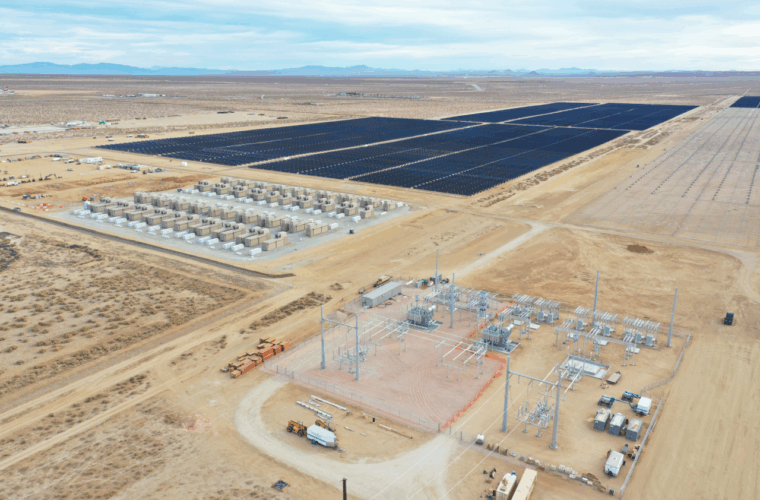
Edwards Sanborn Solar Farm has emerged as a landmark project of global significance, representing the largest single-site solar and energy storage installation in the United States. This colossal facility is more than just a power plant; it is a testament to the scalability of renewable energy and a critical component in the architecture of a decarbonized grid. By co-locating immense solar generation with unprecedented battery storage capacity, Edwards Sanborn directly tackles the challenge of intermittency, providing reliable, clean power to California day and night.
Significance & Context
The Edwards Sanborn Solar Farm is a cornerstone of California’s ambitious mandate for a 100% carbon-free electricity grid by 2045. Its strategic location at Edwards Air Force Base in Kern County allows it to leverage federal land while contributing gigawatts of power to the California Independent System Operator (CAISO) grid. The project’s scale is a direct response to the urgent need for dispatchable clean energy, capable of replacing fossil fuel generation around the clock. Its development is a key milestone tracked by the California Energy Commission in its pursuit of grid reliability and climate goals.
Development Timeline
The development of Edwards Sanborn was a multi-phase endeavor initiated in the mid-2010s, with its scale necessitating a staged construction approach. The project involved complex negotiations and partnerships between private developers, the US Air Force, and the Bureau of Land Management. Major construction phases unfolded between 2021 and 2024, with the final stages of the project and its massive battery storage component achieving full commercial operation in 2024, marking the culmination of nearly a decade of planning and execution.
Technology & Innovation
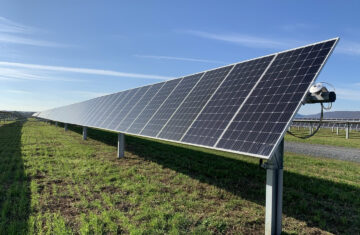
The innovation of Edwards Sanborn lies in its integrated and monumental scale. The project combines over 4,000 acres of solar panels, including both photovoltaic and high-efficiency single-axis tracking systems, with a staggering 2,000+ megawatt-hours of lithium-ion battery storage. This storage capacity allows the project to capture excess solar energy generated during the day and discharge it during the high-demand evening hours, effectively acting as a giant, clean peaker plant. The use of both private and federal land also represents an innovative partnership model for large-scale infrastructure.
Challenges & Controversies
A monumental challenge for the Edwards Sanborn project was the logistical and technical complexity of integrating a record-breaking amount of battery storage. This involved unprecedented electrical engineering to manage the charging and discharging cycles and ensure grid stability. Furthermore, building on a site adjacent to an active Air Force base required meticulous coordination and adherence to strict security and safety protocols. These hurdles were overcome through close collaboration with grid operator CAISO, federal agencies, and technology vendors, establishing new industry standards for hybrid project execution.
Community & Economic Impact
For Kern County, the Edwards Sanborn project delivered an enormous economic stimulus. During its multi-year construction, the project typically employed over 1,000 workers at its peak, creating a massive, though temporary, boom for local businesses. The permanent operations and maintenance team represents a significant cohort of long-term, skilled jobs. The project likely contributes tens of millions of dollars in property tax and lease revenue, a transformative sum for local public services and schools, as documented by the Kern County Administrative Office.
Future Outlook
The completion of Edwards Sanborn is not the end of its story but a beginning. It serves as a living laboratory for grid-scale solar-plus-storage integration, providing invaluable data for future projects worldwide. The site has inherent potential for further expansion as technology improves. More importantly, it stands as a definitive proof-of-concept that solar and storage can be deployed at a scale previously unimaginable, paving the way for the next generation of clean energy projects that will ultimately form the backbone of a resilient, zero-carbon grid.
Also at California: Scarlet Solar farm