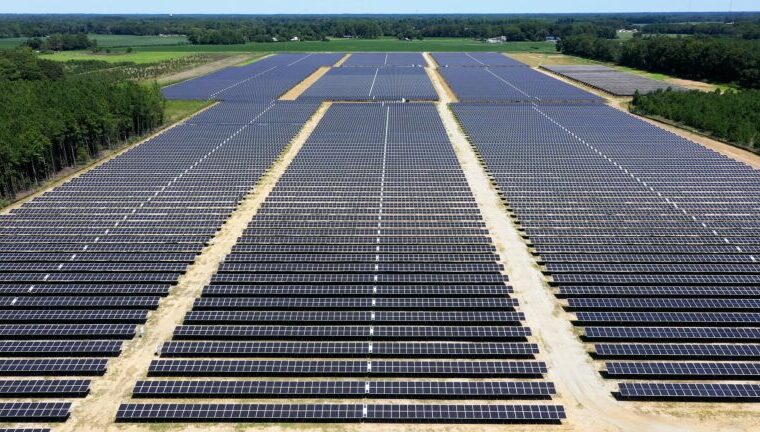
Situated on the coastal plain of North Carolina, the Albemarle Beach Solar Farm represents a strategic advancement in the state’s renewable energy portfolio, demonstrating how solar development can thrive in eastern North Carolina’s unique coastal environment. This project highlights the region’s potential to contribute significantly to the state’s clean energy goals while creating new economic opportunities in rural communities.
Significance & Context
The Albemarle Beach Solar Farm is a 100-megawatt (AC) facility developed by Strata Clean Energy on private land in Washington County. The project’s output is purchased by Duke Energy Progress as part of North Carolina’s competitive procurement of renewable energy, supporting the state’s commitment to reducing carbon emissions under the Clean Energy Bill (House Bill 951). According to data from the U.S. Energy Information Administration (EIA), the facility generates enough electricity to power approximately 18,000 homes. This clean energy contribution displaces an estimated 140,000 metric tons of carbon dioxide emissions annually, supporting North Carolina’s goal of achieving 70% carbon reduction by 2030.
Development Timeline
The project’s development began with comprehensive site assessment and land acquisition in 2019. A key milestone was reached when the project was selected in Duke Energy’s competitive bidding process, which was reviewed by the North Carolina Utilities Commission (NCUC). The development team successfully navigated local permitting with the Washington County Planning Department and completed necessary environmental reviews. Construction commenced in 2022, and the project achieved commercial operation in 2024.
Technology & Innovation
The Albemarle Beach Solar Farm utilizes solar technology specifically engineered for North Carolina’s coastal conditions. The facility features elevated mounting systems designed to accommodate the region’s high water table and flood potential. The project employs corrosion-resistant components and reinforced structures to withstand the humid, saline environment and potential extreme weather events. According to performance data from the National Renewable Energy Laboratory (NREL), this specialized design ensures long-term reliability in coastal applications. Advanced drainage systems and stormwater management features protect both the solar equipment and the surrounding watershed.
Challenges & Controversies
A significant challenge for the Albemarle Beach Solar project involved addressing the site’s hydrological conditions and potential impacts on the sensitive coastal ecosystem. The area’s high water table and proximity to the Albemarle Sound required careful engineering to prevent disruption to natural drainage patterns and water quality. This challenge was resolved through collaboration with the North Carolina Department of Environmental Quality to implement an advanced stormwater management system that exceeds state requirements. The solution included permeable surfaces, vegetative buffers, and specialized drainage infrastructure that maintains natural hydrology while protecting the solar installation.
Community & Economic Impact
The Albemarle Beach Solar Farm provides substantial economic benefits to Washington County. During the construction phase, the project typically employed 200-250 workers, according to workforce estimates from the Solar Energy Industries Association (SEIA). For long-term operations, it supports a permanent team of technicians for maintenance and monitoring. The project provides stable, long-term lease payments to local landowners, creating a reliable revenue source in a region where traditional agriculture faces economic challenges. Based on North Carolina’s tax assessment models for renewable energy, the project likely contributes significant annual tax revenue to Washington County, directly benefiting local schools and public services.
Future Outlook
With an operational lifespan of 30+ years, the Albemarle Beach Solar Farm represents a long-term commitment to eastern North Carolina’s energy future. The project’s success in a coastal environment provides a valuable model for future renewable development in similar regions. The site’s infrastructure is designed with resilience in mind, potentially accommodating future battery energy storage systems to enhance grid reliability during extreme weather events. As North Carolina continues to implement its clean energy transition, the Albemarle Beach Solar Farm demonstrates how coastal communities can participate in the state’s renewable energy economy while protecting their unique environmental resources.
There is another one at USA: Fish Springs solar farm