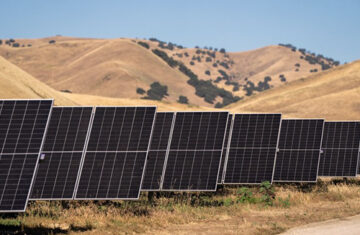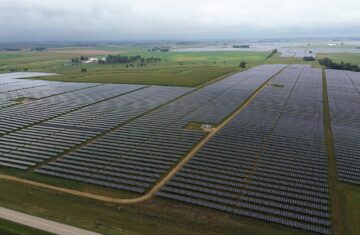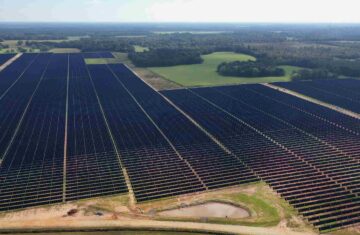

Rising from the sun-drenched landscape of California’s Imperial Valley, the Mount Signal Solar Farm II represents a critical expansion of one of North America’s most significant solar developments, demonstrating how sequential project phases can build upon previous experience to optimize performance, enhance environmental protection, and maximize economic benefits in a region balancing agricultural productivity with renewable energy generation.
Significance & Context
Developed by 8minute Solar Energy, the 200-megawatt (MW) Mount Signal Solar Farm II significantly expanded the Mount Signal complex, contributing to California’s leadership in utility-scale solar generation. According to data from the California Energy Commission, the facility produces enough electricity to power approximately 72,000 homes, substantially supporting San Diego Gas & Electric‘s renewable energy commitments. Its location in Imperial County, which experiences the highest solar irradiance levels in North America, enables exceptional energy production efficiency while operating within the state’s framework for responsible desert development.
Development Timeline
The project’s development leveraged lessons learned from Mount Signal Solar I to accelerate implementation while enhancing environmental protections. Development activities began in 2016, with the project receiving approval from the Imperial County Board of Supervisors in 2017. Construction commenced in 2018, achieving commercial operation in 2020, as documented in California Independent System Operator (CAISO) interconnection records. This streamlined timeline reflected the county’s growing experience with large-scale solar projects and the developer’s improved understanding of local environmental considerations.
Technology & Innovation
Mount Signal Solar II utilized advanced single-axis tracking systems with monocrystalline silicon photovoltaic modules, representing significant technological improvements over the first phase. According to performance data from the National Renewable Energy Laboratory (NREL), these systems increased energy production by approximately 15-20% compared to earlier technology. The project incorporated enhanced water management systems that reduced operational water usage by 80% compared to conventional solar facilities through automated, water-efficient cleaning technology. Improved inverters with advanced grid-support functionality provided better voltage regulation and frequency response capabilities.
Challenges & Controversies
The expansion faced significant challenges related to scale and cumulative environmental impacts. Environmental groups including the California Environmental Justice Alliance raised concerns about additional habitat disturbance and impacts on surrounding communities. The resolution involved implementing an expanded Habitat Conservation Plan that built upon the original project’s mitigation measures, including additional protected habitat establishment and enhanced wildlife monitoring programs. The project also addressed community concerns through improved dust control measures, increased setbacks from nearby residences, and the creation of a community benefits fund to support local environmental and social initiatives.
Community & Economic Impact
For Imperial County, which has consistently faced high unemployment rates, the project delivered substantial economic benefits during both construction and operation. During construction, the project typically employed 300-400 workers, with strong local hiring preferences for county residents. For ongoing operations, it maintains 12-15 permanent positions. Based on Imperial County’s tax assessment models, the project likely contributes approximately $1.4-1.8 million annually in property tax revenue to local governments and school districts. Additionally, it provides stable lease payments to local landowners, creating a crucial drought-resistant income source that complements agricultural revenues and provides financial stability amid water allocation uncertainties.
Future Outlook
With an expected operational lifespan of 30+ years, Mount Signal Solar Farm II has established itself as a long-term asset in California’s clean energy portfolio. The project’s technological advancements and environmental mitigation approaches have informed subsequent solar developments throughout the Southwest. As part of the larger Mount Signal complex, the facility benefits from economies of scale in operations and maintenance. The project’s success in balancing energy production with environmental protection continues to serve as a model for large-scale solar development in sensitive ecosystems, demonstrating that renewable energy expansion can coexist with ecological preservation and community benefits in California’s desert regions.
You can find also at Imperial: Mount Signal Solar Farm V