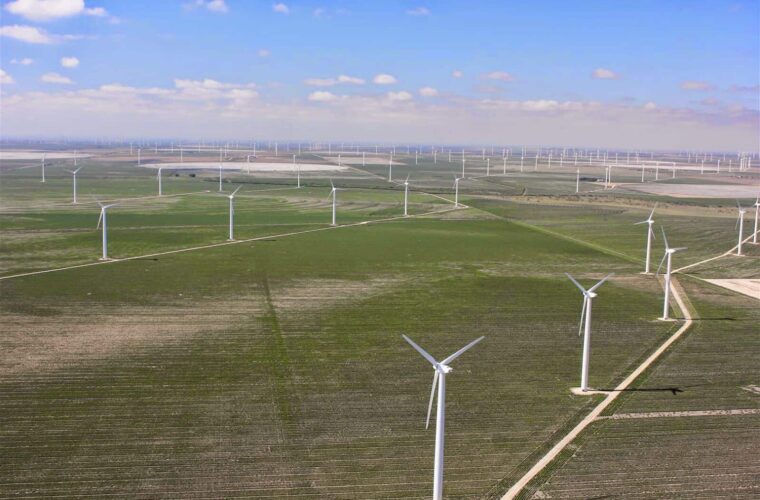
Sprawling across the mesas of Nolan and Taylor Counties in West Texas, the Horse Hollow Wind Energy Center stands as a monumental achievement in the scale and ambition of renewable energy. Upon its completion, it was the largest wind farm in the world, a title that cemented Texas’s status as a global wind power leader and demonstrated the feasibility of utility-scale wind generation.
Significance & Context
The Horse Hollow Wind Energy Center is a massive 735-megawatt (MW) facility developed and owned by NextEra Energy Resources. Its power is sold into the ERCOT wholesale market, providing a substantial volume of clean electricity to the Texas grid. With an initial investment of over $1 billion and spanning nearly 47,000 acres, the project generates enough electricity to power approximately 220,000 homes. Its sheer size upon commissioning in 2006 represented a quantum leap in what was considered possible for wind energy development.
Development Timeline
Development for the Horse Hollow project began in the early 2000s, capitalizing on improving turbine technology and federal production tax credits. The project was built in multiple phases, with the first phase achieving commercial operation in 2005 and the final phase completed in 2006. Its development and interconnection were facilitated by the evolving regulatory framework of the ERCOT market, with its status historically documented in the ERCOT Generation Interconnection Queue.
Technology & Innovation
At the time of its construction, Horse Hollow was a showcase of contemporary wind technology, utilizing a mix of 1.5-MW turbines from GE Energy and 2.3-MW turbines from Siemens. The project demonstrated the logistical prowess required to deploy and interconnect hundreds of turbines across a vast, complex terrain. Its scale required significant upgrades to local substations and transmission lines, contributing to the infrastructure that would later support the dense wind development of the CREST (Competitive Renewable Energy Zones) initiative in West Texas.
Challenges & Controversies
A significant challenge for the Horse Hollow project was a high-profile legal dispute with local landowners who were not participating in the project. They filed a nuisance lawsuit, arguing that the noise and visual presence of the turbines devalued their property. The case ultimately reached the Texas Supreme Court, which ruled in favor of the wind farm in 2010. The resolution affirmed the legal standing of properly permitted wind energy projects in Texas, setting a crucial precedent for the industry and clarifying property rights within the state’s “right to farm” legal framework.
Community & Economic Impact
The project has had a profound and lasting economic impact on the host counties. During its multi-phase construction, Horse Hollow typically employed hundreds of workers. It continues to support a substantial local workforce for ongoing operations and maintenance. Over its operational life, the project has generated hundreds of millions of dollars in property tax revenue and landowner lease payments. This revenue likely contributes massively to the budgets of local school districts and county governments, providing a stable financial foundation while offering ranchers a drought-proof source of income.
Future Outlook
As a foundational asset in the ERCOT fleet, Horse Hollow continues to be a major power generator. Having been operational for nearly two decades, it is now entering a period where repowering—replacing older turbines with newer, more powerful models—is becoming a consideration. As analyzed by the U.S. Energy Information Administration (EIA), such life-extension projects will be key to modernizing the aging U.S. wind fleet. The repowering of Horse Hollow would represent another landmark investment, ensuring this record-setting project remains a cornerstone of Texas’s energy supply for decades to come.
Also at Texas: Sweetwater Wind farm