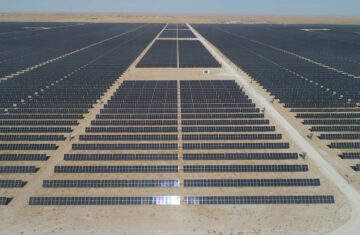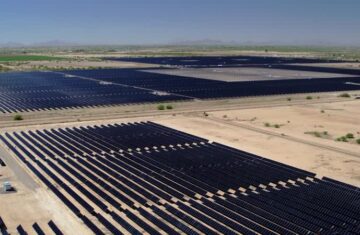
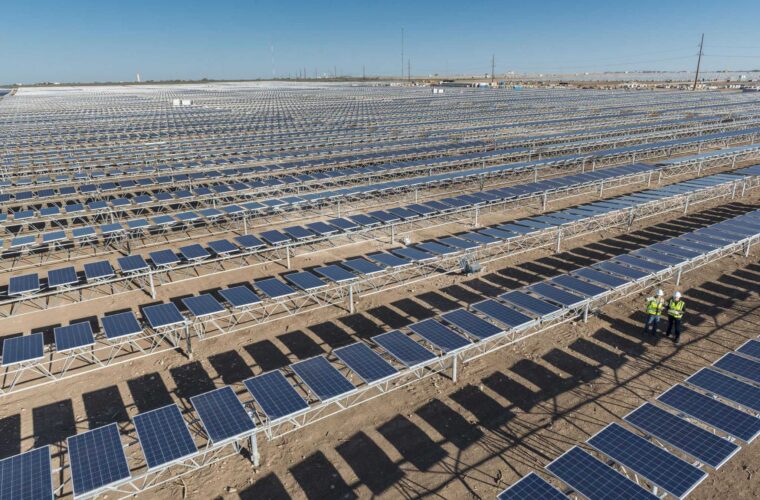
Rising from the Chihuahuan Desert of West Texas, the Alamo 6 Solar Farm represents the strategic expansion of renewable energy in one of America’s most prolific energy-producing regions, demonstrating how solar development can complement traditional oil and gas operations while diversifying local economies. This project exemplifies how areas with extreme environmental conditions can be transformed into productive energy assets, contributing to grid reliability while creating new economic opportunities in rural communities.
Significance & Context
Developed by OCI Solar Power, the 100-megawatt (MW) Alamo 6 Solar Farm contributes to Texas’ nation-leading renewable energy capacity while operating within the competitive Electric Reliability Council of Texas (ERCOT) market. According to generation data from the U.S. Energy Information Administration, the facility produces enough electricity to power approximately 30,000 homes, leveraging West Texas’s exceptional solar resources that rank among the highest in the United States. Its location in Pecos County positions it within a region historically dominated by oil and gas production, demonstrating the energy sector’s evolving diversification.
Development Timeline
The project’s development progressed efficiently through Texas’s market-friendly regulatory environment. Development activities began in 2019, with construction commencing in 2021 following execution of power purchase agreements with commercial and industrial off-takers. The project achieved commercial operation in 2023, as documented in ERCOT Generation Interconnection Queue reports. This timeline reflects the relatively streamlined permitting process for renewable projects in Texas, though it still required comprehensive environmental review and community engagement to address local concerns.
Technology & Innovation
Alamo 6 Solar Farm utilizes single-axis tracking systems with bifacial photovoltaic modules, capturing both direct sunlight and reflected light from the desert surface. According to performance studies from the National Renewable Energy Laboratory (NREL), this technology combination can increase energy yield by 8-15% compared to conventional single-sided panels. The project incorporates advanced inverters with grid-forming capabilities, providing essential voltage support and frequency regulation to enhance stability in the remote West Texas grid. Dust mitigation systems and automated water-free cleaning technology maintain panel efficiency while minimizing water usage in the arid environment.
Challenges & Controversies
The project faced significant challenges related to extreme environmental conditions and infrastructure limitations. The desert location presented difficulties with dust accumulation, high temperatures, and limited water availability for construction and maintenance. These were resolved through engineering solutions including specialized dust-resistant components, elevated mounting systems for improved airflow and cooling, and implementation of water-free cleaning robotics. Additionally, the remote location required upgrades to local access roads and coordination with ERCOT to ensure grid stability, with costs shared between the developer and local infrastructure improvements.
Community & Economic Impact
For Pecos County, the project has delivered valuable economic diversification alongside traditional energy sectors. During construction, the project typically employed 150-200 workers, providing local employment opportunities in a region with limited job diversity. For ongoing operations, it maintains 4-6 permanent positions. Based on Pecos County’s tax assessment models for utility-scale solar, the project likely contributes approximately $250,000-$350,000 annually in property tax revenue to local governments. Additionally, it provides stable lease payments to local landowners, creating a reliable income source that complements royalty revenues from oil and gas operations, providing economic resilience through energy market cycles.
Future Outlook
With an expected operational lifespan of 30+ years, the Alamo 6 Solar Farm represents a long-term investment in Pecos County’s energy future. The project’s success in harsh desert conditions provides valuable operational data for future developments in similar environments. As Texas’ grid continues to evolve following weather-related reliability challenges, the project’s ability to provide zero-marginal-cost energy during peak daylight hours contributes to overall grid stability. The project’s co-existence with traditional energy operations demonstrates a practical model for energy transition that respects existing economic foundations while embracing new opportunities, positioning West Texas communities for continued leadership in America’s diverse energy landscape.