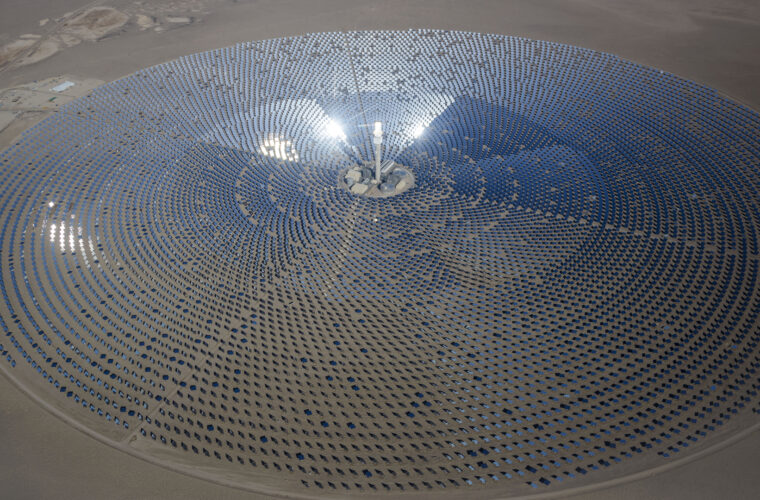
The Crescent Dunes Solar Energy Project in Nye County, Nevada, was envisioned as a revolutionary beacon for the future of renewable energy. As one of the first commercial-scale concentrated solar power (CSP) plants with integrated molten salt energy storage, its promise was not just to generate clean power, but to deliver it on demand, even after sunset. Its development, supported by a $737 million loan guarantee from the U.S. Department of Energy as part of its SunShot Initiative, was a bold attempt to solve renewable energy’s most pressing challenge: intermittency.
Significance & Context
Crescent Dunes was a flagship project designed to showcase next-generation solar technology. Unlike common photovoltaic (PV) farms, its CSP technology used 10,347 mirrors (heliostats) to concentrate sunlight onto a central receiver tower, heating molten salt to over 1,000°F. This innovative design allowed the 110-megawatt (MW) facility to store 10 hours of thermal energy, enabling it to power approximately 75,000 homes day and night, as outlined in its power purchase agreement with NV Energy. This capacity was intended to significantly reduce reliance on fossil fuels for baseline power.
Development Timeline
Developed by SolarReserve, the project’s timeline encapsulates both great ambition and subsequent difficulty. Construction began in 2011 and reached commercial operation in 2015. However, as documented in a U.S. Government Accountability Office (GAO) report on renewable energy investments, the plant almost immediately faced operational problems. After failing to meet its output obligations, it ceased operations in 2019. In 2020, the project’s owner, Tonopah Solar Energy, filed for Chapter 11 bankruptcy, marking a dramatic fall for what was once a symbol of American innovation.
Technology & Innovation
The core innovation of Crescent Dunes was its use of molten salt as both a heat transfer fluid and a storage medium. This technology, detailed in technical reports by the National Renewable Energy Laboratory (NREL), was a significant advancement over older CSP systems. Heating salt directly was more efficient and allowed the system to store massive amounts of thermal energy for use when electricity demand peaked in the evening. This “dispatchable” capability was its key differentiator, intended to provide grid stability and prove that solar could be as reliable as conventional power plants.
Challenges & Controversies
The project’s primary hurdle was technical and ultimately financial. Persistent issues plagued the system, including leaks in the molten salt storage tanks and problems with the heliostats, which prevented the plant from achieving its designed output. These technical failures, as reported by industry watchdogs like Reuters, led to a critical revenue shortfall. The plant could not fulfill its power purchase agreement, leading to its bankruptcy and shutdown. Its failure served as a cautionary tale about the risks of scaling complex new technologies.
Community & Economic Impact
During its construction peak, the project typically employed over 600 workers, providing a significant temporary boost to the local economy in Tonopah. It likely contributed substantial payments to local landowners and was a notable contributor to Nye County’s tax base during its brief operational period. However, its bankruptcy and closure resulted in the loss of an estimated 45 permanent operations and maintenance jobs, negating the long-term local benefits that had been anticipated, a common economic impact noted in analyses by the Solar Energy Industries Association (SEIA).
Future Outlook
The future of the Crescent Dunes site remains uncertain. While the technology itself demonstrated a proof of concept, the project’s financial failure has cooled investor enthusiasm for similar large-scale molten salt CSP facilities. The facility was acquired by the investment firm Arevia Power in 2021, which, according to reporting in the Las Vegas Review-Journal, has explored repurposing the site. The tower itself stands as a monument to an ambitious vision of solar power that, in this instance, proved too complex and costly to sustain.